Your workforce is building agents in Salesforce Agentforce, Microsoft Copilot Studio, Cursor, Zapier, Retool, and a dozen other tools, often without visibility or approval from IT or security.
For IT and security teams, the decision of whether or not agents should be used has already been made by the business, one shadow agent at a time. The challenge now is keeping up. New agents can be created in minutes, connected to sensitive systems in a click, and changed daily.
The job is to maintain visibility and control (who built it, what it can access, what it can do) while enabling the workforce to keep experimenting, automating, and moving fast.
That’s exactly what Nudge Security does.
AI chatbots are a known problem by now. Shadow AI agents are a different, and arguably bigger, one. An agent holds persistent permissions. It connects to your corporate apps and data. It takes action on its own, without waiting for someone to hit send.
That gap between exposure and readiness is exactly where shadow AI agents live.
Learn how each approach works, what it actually detects, and where the blind spots are, so you can build a discovery strategy that matches your real agent risk surface.
As AI agents multiply across your stack, the gaps between methods are where risk hides.
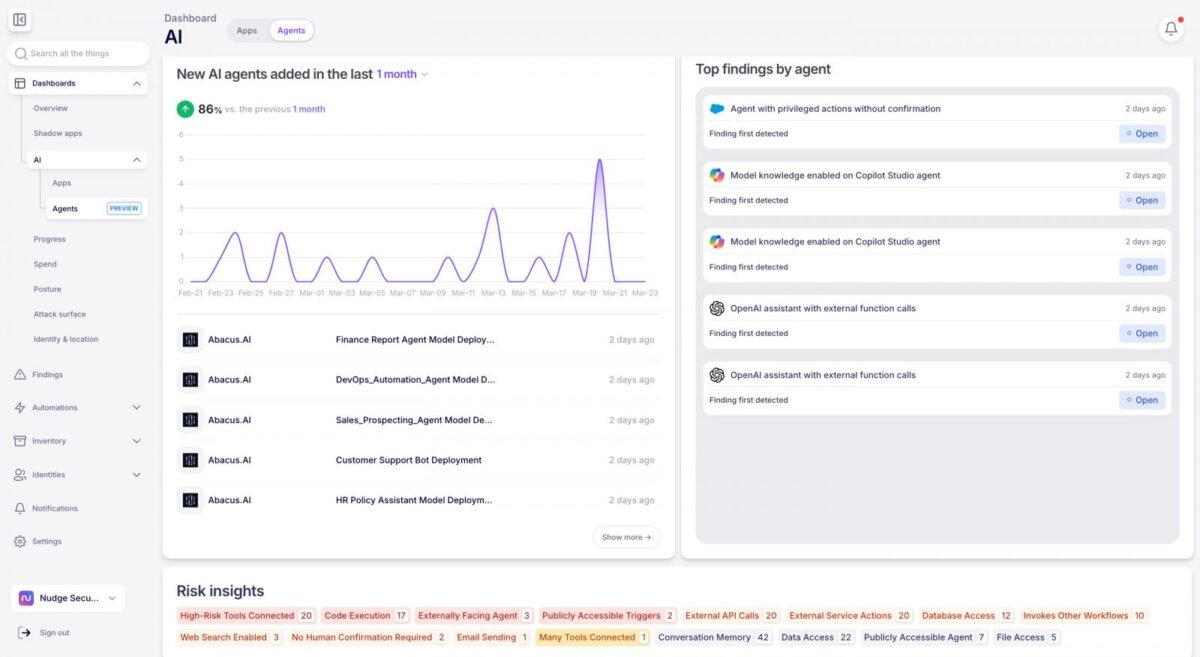
You can’t govern an agent you don’t know exists. Nudge Security gives you an immediate inventory of AI agents, across the most popular agentic platforms including Microsoft Copilot, Google Gemini, ChatGPT, Claude Managed Agents, Tines, ServiceNow, Salesforce Agentforce, Cursor Automations, and many more.
No spreadsheets. No self-reporting. No waiting for an incident to find out what’s already running in your environment.
Most AI agent discovery methods have the same blind spot: they only see what agentic platform vendors choose to expose through a public API. That leaves out an enormous amount of shadow AI activity, because a lot of the platforms where employees build agents don’t offer an API, or don’t expose agent details through it.
Nudge Security closes that gap with two complementary discovery methods:
API-based discovery connects to the platforms that do expose agent data: Salesforce Agentforce, Microsoft Copilot Studio, Google Gemini, ServiceNow, n8n, Tines, ChatGPT, Abacus.AI, and Workato. It continuously pulls agent name, creator, creation date, status, configuration, and risk insights.
Browser-based discovery, through the Nudge Security browser extension, covers the platforms that don’t expose an API at all: Cursor automations, OpenAI Agent Workflows, ChatGPT workspace agents, Zoom AI Workflows, Atlassian Rovo, Retool, Zapier Agents, and HyperAgent. The extension passively observes the moment an employee views, lists, or creates an agent, then adds it to your inventory automatically, with the creator, connected apps, permissions, and risk signals already attached.
Between the two channels, Nudge Security covers 17+ agentic platforms today, and the list keeps growing based on where customers are actually seeing agent activity.
The agents built on platforms without APIs aren’t a minor edge case. They’re often where the real shadow AI lives. These are the fast, low-friction tools your engineers, ops teams, and product managers already love, precisely because nobody has to ask IT for permission to use them.
That’s also why they tend to carry the broadest access and the least oversight. An agent built in an afternoon to save someone twenty minutes can end up with standing access to a CRM, a code repository, or a shared drive, and no one outside the person who built it knows it’s there.
Finding an agent is only useful if you know what it’s capable of. For every agent it discovers, Nudge Security automatically surfaces these agentic AI risks:
Discovery tells you what’s out there. Governance is what you do about it, and Nudge Security is built so that step doesn’t require your team to chase down every agent creator one by one.
Once an agent is in your inventory, you can:
It’s proactive AI governance that doesn’t ask you to play whack-a-mole with every new agent that pops up, and it doesn’t ask your workforce to slow down to get security’s blessing before they build something useful.
Your job isn’t to stop people from building agents. It’s to make sure that when they do, someone knows it happened, knows what the agent can touch, and can act fast if something looks wrong.
Nudge Security gives you Day One AI agent discovery with risk context and governance workflows across the agentic platforms your employees are actually using.
Sponsored and written by Nudge Security.
OpenAI confirms ChatGPT is down worldwide
Malicious sites use JavaScript to build malware in browser memory
ShinyHunters data leaks fuel $2,000 sextortion email scam
Your Scanners Are Green. Your Pipeline Might Not Be. Here’s How to Close the Gap.
Rev5 is ending. See what your FedRAMP 20x transition really requires
Overdue a password health-check? Audit your Active Directory for free
AI agents can speed up ransomware attacks. See how Acronis helps reduce the risk.
Uncover shadow AI apps, agents, and risky data sharing. Get started in 5 min.
Terms of Use – Privacy Policy – Ethics Statement – Affiliate Disclosure
Read our posting guidelinese to learn what content is prohibited.