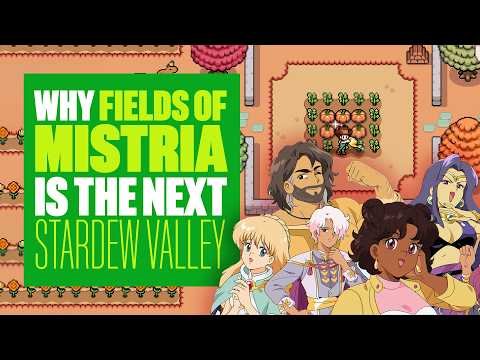
I plant a dozen turnips, buy a pair of chickens and then get back to business: digging up treasures to gift to the hot witch running the town’s bathhouse.
Released last week after two years of early access, Fields of Mistria promises to be a spiritual successor to the farming sims of the late 1990s. And it’s true that the game’s initial premise feels like the classic Harvest Moon formula: turn up and revitalise a struggling town, winning hearts and rosettes along the way. This is not the first time a modern farming sim has reimagined that idyllic take on rural life. Unless you’ve been living under a rock – perhaps in the mines – then Stardew Valley is the most famous example, exploring countryside living through a Pacific Northwest lens, but there are plenty of other games coming out right now that want a slice of the proverbial prize-winning pie.
Almost immediately, however, Fields of Mistria proves itself to be a different beast. In the first place, it’s very relaxed about the actual farming. Anyone who says farming sims are inherently cosy hasn’t run a ranch with the spirit of an agricultural megacorporation. In many cases, Stardew Valley included, the game becomes less about learning to live alongside nature and more ‘how can I make more wine than god.’ Move over Del Monte; give me fifty hours with a plot of land and I will show you the meaning of monoculture.
The world of Mistria is resistant to that impulse. There are real, incentivised reasons to try a bit of everything, from fishing to farming to pissing off the blacksmith by making better swords than him. Caldarus, the aforementioned dragon statue, offers perks in exchange for essence gathered through your efforts, so it’s good to diversify what to work on day to day. Sometimes that means exploring the mines until the last possible moment. Sometimes it’s clearing rubbish from the farm in order to build a cow playpark. The game treats both as equally valuable, preventing it from the automation trap many farming sims can fall into.
In fact, for a game set in a fantasy world of witches and positive relationships with the gentry, Fields of Mistria adopts a surprisingly grounded approach to what your farm can do. Yes, there is a spell to summon a storm and water the fields, but the crops themselves are familiar. Unlike in Story of Seasons: A Wonderful Life, your farmer doesn’t spend their time tending to bluenanas or cursed turnip / melon hybrids. There are only a handful of different crops per season and they’re all rather sensible; Mistria is going to be saved through the hauling of good old fashioned corn and potatoes, though you can forage and grow herbs if you’re feeling fancy. If anything is fantastical it’s the local flowers, but even they are based on real-life equivalents.
The ranching mechanic continues this trend towards realism. Alongside cows and chickens the farm can house horses, ducks, sheep and alpacas (and capybara, for extra cuteness), setting it apart from many other fantasy farming sims, who often tread the path of unusual or exotic creatures. Fields of Mistria sticks to pink chickens. Or colour-shifting alpacas, obtainable through the RNG-based breeding system: but the coats are a simple cosmetic variation, and at the end of the day the wool is the same. It becomes a lot easier to concentrate on raising the affection of your animals when you don’t have to worry about what they’re going to leave in the barn in the mornings.
All this, and the decision not to include a range of complex artisan stations, contributes to Fields of Mistria encouraging players to go beyond the confines of the farm and focus on the cream of the crop: the cast of characters.
The townspeople of Mistria are a colourful bunch, and possibly the best dressed cast seen in an RPG in a long time. They are unmistakably 90s coded. Big shoulder pads meet bigger fringes, there are more Sailor Moon references than there are Sailor Senshi, and half the townspeople sport at least one item of clothing I’d have saved up to buy in Tammy Girl.
Thankfully, the game allows players to set 8 outfit presets (complete with magical girl transformation sequence) preventing you from feeling underdressed at any given time. New clothing items and accessories are frequent rewards for story progression, which means you can wear anything from magical robes to Zoolander-inspired mining fits. Sartorial splendour is serious business in this town.
Although appearances are important and Fields of Mistria places heavy emphasis on its visuals, the NPCs don’t just look good. Everyone is as full of personality as they are of clothing inspiration. Yes, you’ll meet the bright-eyed fellow newbie farmer and butt heads with the grumpy rival character; but everyone has layers, like an onion. Many of the Mistrians feel like rehashes of farming sim stock characters, though it can be forgiven since they’re so charming.
Fields of Mistria even features older people. And (shock horror) they’re cool! Avoiding the JRPG cliché of portraying anyone over 35 as decrepit, the local elders are as fashionable and full of personality as those who are single and ready to mingle.
Above all, though, people feel like they know one another. The cast have relationships outside of the player. They play Dragons & Drama together, engage in mild gambling, and reminisce on stories ranging from living on the road as a travelling musician, to who drank the most dirty pints back in the day. Events happen around you and without your influence, and it never feels as though it’s someone’s first day on earth. Developer NPC Studio has delivered a balance between selling these friendships without sliding into voyeurism.
Take Friday Nights at the Inn, for example. This is a weekly event that sees the entire town gathered at The Sleeping Dragon Inn, where the player listens in on various ongoing plots and conversations that evolve over time. After playing through several seasons in the 1.0 release I’ve yet to come to the end of these stories. Running to the inn after work on a Friday has become one of the highlights of the game, in a serious case of art imitating life; I don’t want to miss out on either the gossip or the free cocktails. There is a massive volume of dialogue here and everywhere, and much of it is both funny and cleverly timed.
Placing such a huge emphasis on conversation is another thing that makes Fields of Mistria outstanding in its field. Building relationships in life sims can often feel like a checkbox exercise of listening to the same recycled dialogue and throwing forage at your intended until they give you the time of day, but it’s different in Mistria.
Talk to Balor the merchant near his stall, and he’ll discuss his wares. Talk to him again in the inn and he’ll remark on his lunch, or whether you’re there for the free soup. If you run around town in the morning people will compliment you on being an early bird, whereas late night meandering will elicit chat around the merits of moonlit walks. The townspeople congratulate you on a job well done when you work on restoring the town, and enthuse about an artifact you’ve donated to the museum. They have so much to say that I sometimes spend entire days wandering around making conversation. It’s not productive, but it’s fun, and the game doesn’t punish players for taking a while to reach its objectives.
Not everything is sunshine and roses in Fields of Mistria. A month prior to the 1.0 launch the game migrated to a new engine and though it promised greater stability, I’ve seen significant drops in performance at times. When it’s raining or snowing the frame rate can struggle badly, and at points my character moves as though they’re running through treacle, which feels frustrating in combat situations. Capping the performance to 60fps does help somewhat and you can optionally reduce weather particles, but I’d rather experience them as intended.
Performance aside, the main thing holding the game back is the lack of seasonal festivals, and cutscenes with people outside of the eligible marriage candidates. Festivals are the secret sauce of many farming sims, and I was surprised that Fields of Mistria’s events are limited to one per season. On the bright side, the few that exist in-game right now are well worth attending, and players seem confident the developers will add more as the post-launch schedule develops. Like Stardew Valley’s 1.x updates, the team have said they’ll keep adding new things to Fields of Mistria, so I live in hope of a beach festival and the chance to see my favourites in their beachwear.
As it’s only a week post-launch these complaints could possibly become obsolete, and neither overshadow Fields of Mistria’s many small but welcome improvements. Without even talking about the traversal mechanics (you can jump!), there are a lot of little features that amount to a stress-free experience. Crafting draws on items in both your inventory and in storage, and shops don’t have set opening hours, meaning you can buy cat treats at 1am as nature intended. The map shows everyone’s locations – handy for those days where you will inevitably want to chitchat around town – and possibly the most exciting feature is the fact that cutscenes trigger regardless of the target character’s presence. People who have played classic Harvest Moon entries will rejoice at no longer having to haunt a location until the object of their affections shows up, which both wasted time and felt weird. There are also rumoured dates, but nobody likes me well enough yet to invite me on one.
Time will tell on that front, so in the meantime I’ll be entering my villein era while my pastel-pink cows play with an inflatable beachball. The life of an adventurer in Fields of Mistria is tough, but it’s worth it.
A copy of Fields of Mistria was independently sourced for this review by the author.