
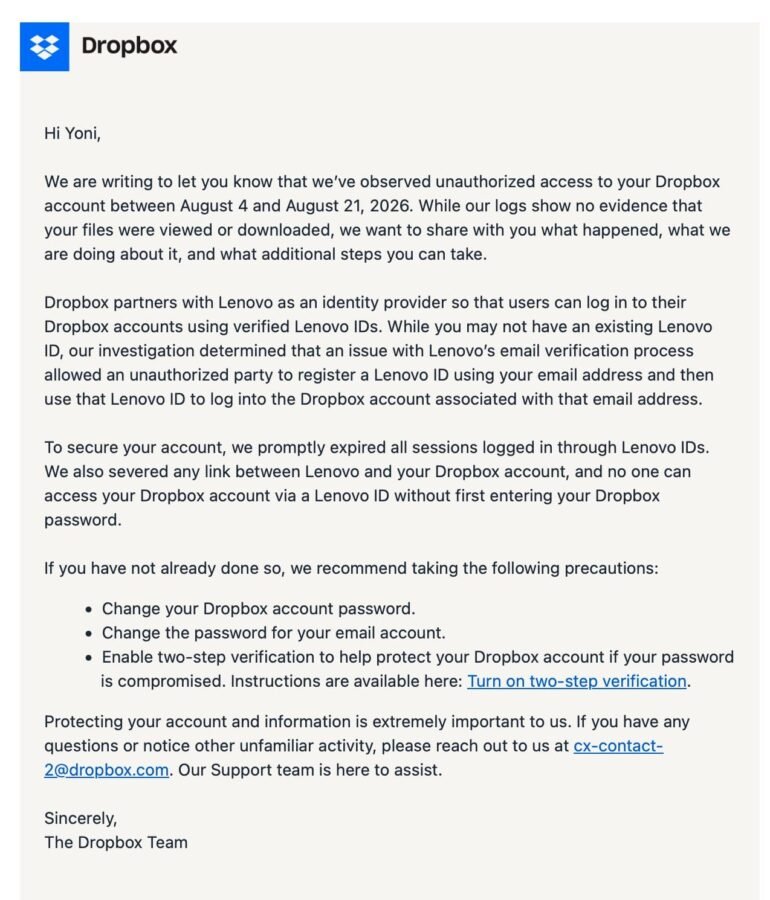
Dropbox is warning some users that an unauthorized party accessed their accounts by exploiting a flaw in Lenovo’s email verification process to register fraudulent Lenovo IDs.
Although some affected users did not have Lenovo accounts, the cloud-storage provider said it uses Lenovo Identity Provider Services as part of its authentication infrastructure. This allows users to log into Dropbox accounts using verified Lenovo IDs.
According to the notification sent to impacted users, the unauthorized access was possible due to “an issue with Lenovo’s email verification process,” which “allowed an unauthorized party to register a Lenovo ID using your email address.”
The attacker then used the fraudulent Lenovo ID to access the Dropbox account registered under the same email address without needing the login password.
Dropbox’s identity-linking process trusted Lenovo’s assertion that the attacker controlled the email address without requiring confirmation through the existing Dropbox login method.
“While you may not have an existing Lenovo ID, our investigation determined that an issue with Lenovo’s email verification process allowed an unauthorized party to register a Lenovo ID using your email address and then use that Lenovo ID to log into the Dropbox account associated with that email address.”
Some Dropbox users reported receiving “about two weeks ago” notifications about suspicious Dropbox sign-ins and immediately changing their password and activating two-factor authentication (2FA).
“One odd thing at the time: the Dropbox login page had started offering ‘Continue with SSO’ for my email even though I never created a Lenovo ID,” user xaphod said.
The cloud storage company determined that the attacker accessed users’ Dropbox accounts between August 4 and 21.
In a statement for BleepingComputer, Lenovo said that the issue was related to a legacy integration between Lenovo ID and Dropbox, which could be leveraged “to improperly authenticate certain Dropbox accounts.”
“Upon identifying the issue, Dropbox and Lenovo worked collaboratively to promptly mitigate the risk,” a Lenovo spokesperson told BleepingComputer.
The investigation into the incident continues, but the company determined that Lenovo customers were not affected by the issue.
Dropbox responded by expiring all sessions authenticated through Lenovo IDs and adding a new login requirement mandating that users enter their Dropbox account password when attempting to use Lenovo ID authentication.
It is unclear how many Dropbox users are impacted by the incident. BleepingComputer has contacted Dropbox for additional information, but we have not received a response as of publication.
Overall prevention scores can hide what happens after initial access. Once attackers are using valid credentials, prevention drops sharply.
The Blue Report 2026 measures defenses technique by technique across 338 million simulations run in customer production environments.
Sakura Internet hack exposes data of up to 1.36 million accounts
Novocure data breach affects more than 1,400 cancer patients
Aesto Health says data breach affects over 9.5 million patients
Berlin confirms data theft after Rhysida ransomware attack claims
FulcrumSec claims Manchester Airports hack, theft of 86 GB of data
Massive Microsoft 365 outage causes auth issues, service failures
Anthropic warns infostealer malware is hijacking Claude sessions to drain usage
Chrome Web Store extensions caught stealing crypto, browser data
Learn how ESET MDR can enhance your organization’s security posture
Pixellot discovered and secured hundreds of unmanaged AI agent identities in weeks, not months. Download the case study for how.
AI-driven vulnerability discovery is accelerating. See how Action1 helps remediation keep pace.
Can you trust every session? See how session enrichment enables better authentication decisions.
Identity, Data Governance & Threat Detection in One Platform: Take our In-Browser Tour
Terms of Use – Privacy Policy – Ethics Statement – Affiliate Disclosure
Read our posting guidelinese to learn what content is prohibited.