Post-its, emotions, and looking up "verisimilitude".
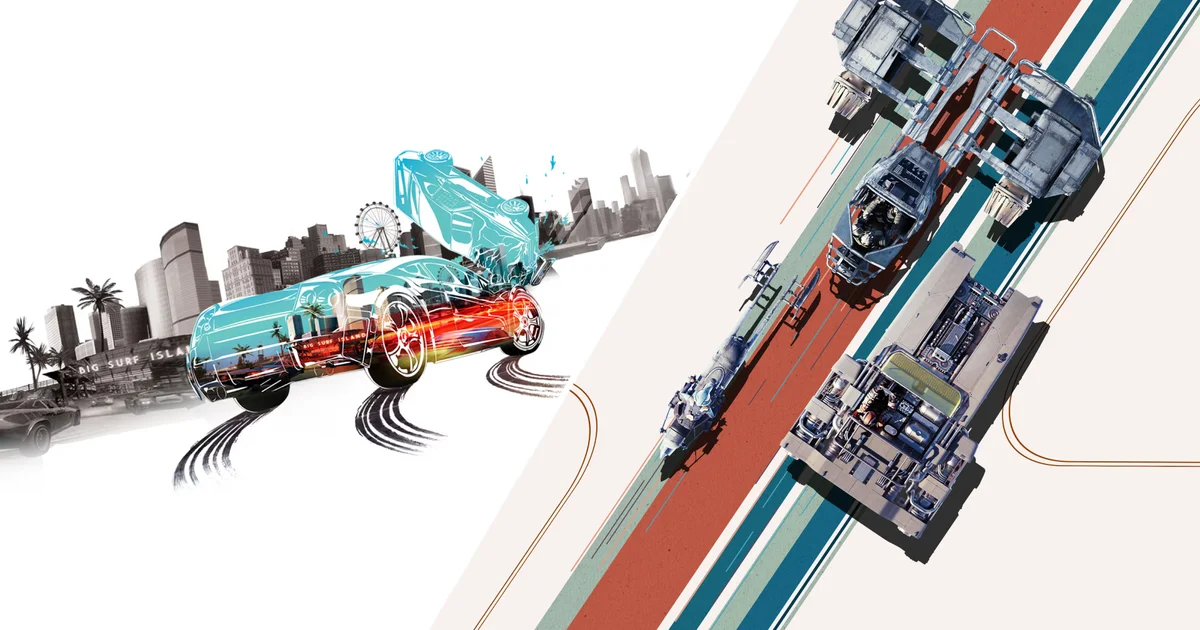
But what does it mean for a game to feel like Burnout? And how do you make a game that channels the junky, battered-tech side of Star Wars? I spoke to some of the people behind Galactic Racer to find out.
So here’s a quick chat with Matt Webster, the CEO of Fuse Games, along with Kieran Crimmins, the creative director at Fuse, and Craig Derrick, executive producer at Lucasfilm Games. It touches on everything from “game feel” and emotion to board game prototypes and Richard Donner’s Superman.
I had a moment when I started my first game, and I set off, and I waited until I would normally press boost in Burnout, and then I pressed the boost button from Burnout, and it did exactly what I thought it was going to do if I had been playing Burnout. I think a lot of people know your lineage from Criterion. They will be thinking along the same lines as I was, and I wondered how you feel about people having that experience: the rediscovery of the Burnout boost.
I think that what you’re describing is not just the boost mechanic: press a button and go faster. It’s everything that happens when you depress that button. We reduce it down into: button goes down, speed goes up. But there is clearly more going on there. But yeah, the game feel part is extraordinarily important. It’s a throughline throughout the entire experience. Because if you can suspend your disbelief on a primary sensory level, then we can immerse you so much more powerfully in everything else that’s going on as well.
Does this search for game feel help to dictate the way you approach Star Wars? This is the Star Wars of brilliant but sometimes decrepit technology that can go really fast but can also break at the worst moment.
Matt Webster: That’s not us. That’s this wonderful galaxy that we get to play in. It’s all there for us to lean into. The game is a combination of our love of racing and our love of Star Wars. We come at it as fans, and we see those details too, and it’s just that we have the wonderful privilege to be able to put some of them into action. The tactile nature: bashing something to get it to work. I always call that “touch sensitive”, right? That leads to flicking levers and doing button combinations at race start. That’s never getting old. That’s the thing that connects you into the tactility of the galaxy.
When I look at Burnout, there’s a grippiness to that game. In Paradise, you feel like your wheels are almost traveling in grooves in the road. So when you approach a game where you don’t have wheels, how do you get a sense of connection to the road?
Matt Webster: What you’re just describing again is an attention to game feel that I think we have a very particular point of view on. It just so happened in something like Burnout, for us at least, the best way around a corner in a car is sideways with all four wheels straight. But that’s actually quite difficult to do. To deconstruct the intention there: the average driver doesn’t think they’re an average driver, right? We all think that we’re incredible. And that’s the fantasy we’re trying to do here. The starting fantasy is to be an incredible racing pilot.
And actually it’s pretty liberating to be decoupled from tyres on tarmac. We can do different things, exciting things. We can amplify the vertical. We can amplify the angles. But it’s all built on some pretty significant foundations. Which are: if you could invent a levitating jet engine on Earth, it would behave in this way because we built a simulation to deliver it. And the reason you do that is because we’ve all got an innate understanding of the physical world around us. There is a physical simulation going on there. And it’s inspired by everything that we’ve seen about Star Wars, from the podracers to the land speeders to the speeder bikes to every vehicle that we’ve seen there.
When you pay so much attention to game feel and you control the experience in that way to give players a very specific sensation, what’s it like to then add Roguelite features and give players control over what they build? Does that feel like giving away control or does it feel like something else?
Matt Webster: Fundamentally we define the container. And because those rulesets and those systems are cared for and crafted and balanced. We want to push the genre forward. I [often] talk about [how] arcade is not the absence of depth. It’s your route into it. And then we reveal that depth in accessible and approachable ways for you to go and play.
Kieran Crimmins: And the things you’re [building your vehicle with], we would call our player story generator. The point of creating all these physical toys, which is essentially what they are from a fundamental level, is so that you can play with them like you would play with your toys. That means stacking them on top of each other, creating something that you wouldn’t expect. But then it reacts in a way that feels physical and real and expected, but it’s also yours. What we try to do is create moments of emotion for players. I mean, game design, on this fundamental level, is systems that create emotions, right? So we target emotions from Star Wars. We target emotions from racing. We target emotions from the story, and then we turn them into play. We turn them into interactive experiences. So we don’t need to curate everything that happens along a timeline because we give you a set of toys that are the experiences that create that racing thrill.
Is it hard to put all those pieces together? The vehicle parts and upgrades?
Kieran Crimmins: We like many things. We have loads of ideas, and we have references and emotions that we’re trying to get to. But you can’t know if you’ve got game feel. You can’t know if you can feel the system until you can play the system. So we just try and get into [the] prototype [stage], get it into our players’ hands. See if they’re feeling those emotions. So rather than worry about whether it’s the right set of things, we worry about getting it as a play experience as quickly as possible and seeing if it feels right. And that’s how we ended up with those things [we have to play with in the game]. They were actually part of the original board game for the early prototype.
I’ve got to stop you. Tell me about the board game prototype.
Matt Webster: It’s a prototyping story. What’s the fastest way we can get ideas down and then talk about them. You know, modern engines are so capable that you can do a lot of in software, but there’s still something [about that that is] not as fast as getting a written idea down. From a board game perspective, you sort of decouple yourself from a particular prototype and you’re talking about moment-to-moment.
Kieran Crimmins: There’s a prototyping tool for every kind of system that you want to prototype, and the one that you pick should be the one that gets you there the quickest, and gets you to validate the emotion the quickest. So when it came to upgrades and meta progression, I can do a board game in a day. I mean, I say “board game”. A lot of it is Post-its and a scribble and some dice. But we’re trying to validate those feelings as quickly as possible. So you just pick the best tool for the moment.
I’m struck by how much you talk about emotions in your game design process.
Craig Derrick: Emotions are the new verbs, you know. Kieran, you’re going to nail this, but I’m just going to say, when we’re talking about the experience of play and the agency that you want to feel through those moment-to-moment experiences, how can you not describe it as an emotional state?
Kieran Crimmins: I think you’re absolutely right. I think it’s fair to say, what’s the point in all this if you’re not feeling something? Yeah. Like whether that’s games, walking through the park, whatever it is, that is the ultimate goal: to create some strong emotions, and that be some sort of reflection of your thing of playing. It’s always been at the heart of everything we do everywhere I’ve worked where we make games.
Matt Webster: Maybe as an industry we don’t talk about it enough, but when we talk about games, we’re actually talking about how it made us feel. So it is always is all about emotion, whether it’s the sensory feel or the or the emotional feel or the what’s motivating me. I tell this story a lot. One of the original superhero movies was the original Superman, directed by Richard Donner. I remember watching the DVD extras, and he was sat in front of his production desk talking about the movie, and behind him was this massive word, and it said ‘Verisimilitude.” I had to look it up. It was graffitied on the wall behind him.
And essentially, it means the truth of the thing, or the truth of the heart. It stuck with me a lot, right? Because what he said was, “If you don’t believe a man can fly, it doesn’t matter what else we do. If, fundamentally, you don’t believe a man can fly, nothing’s going to work.”
So if you don’t believe that you are in the Star Wars galaxy, that you are piloting this land speeder around at 600 kilometers an hour. If you don’t believe that, then it doesn’t matter what story we’re doing, the awesome stuff that we’re doing in the paddock, and this sports story that we’re telling. If you don’t believe that at the heart, then we can’t do all the other stuff. And that brings us back to that starting point of why that sort of stuff is really important, on that very base, foundational level.