"They successfully identified that their target market was people with no imagination."
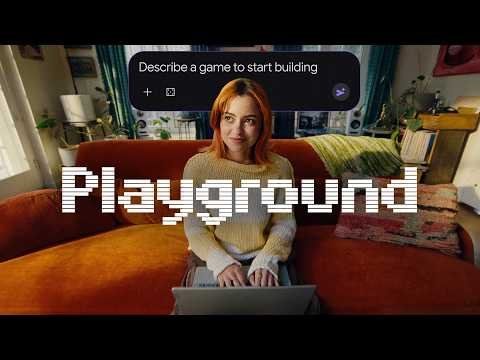
Their side-by-side announcements are more than coincidence. Google Playground will work with and integrate Unity Spark when “creators” want to “expand their concepts” with “robust, professional-level mechanics, high-fidelity 3D capabilities”, Google’s Playground blog post said.
Given that, there’s a sort of two-tiered approach going on here. Google Playground is the entry level platform, a much more – excuse me while I throw-up on myself – ‘vibe-coded’ idea origination tool. It’s the sort of thing you plug a load of words into the text box, presumably while marvelling at your own creativity and taking lifestyle selfies on a beach somewhere, while Google Playground builds a fairly simple game. Then, when you’re happy with it, and AI-prompting a post on LinkedIn about your career change, you can share the game with other Playground users.
Said Google: “Games are one of the most creative forms of expression, and the gaming community keeps growing. But game creation has historically been limited to a select group of people who have technical experience and knowledge of complex game engines. Today, we’re introducing Playground, an experimental gaming platform that lets you create, play, and share custom games. Playground lowers the barriers to creation, so bringing game ideas to life can now be as easy as describing it through a few prompts — no coding experience required.”
Unity Spark, on the other hand, is a more complicated affair. There are text prompts but they work more as shortcuts or helpers within Unity’s more traditional game engine package, so it’s not just a ‘whack a load of text in, sit back, and create’ kind of affair. Indeed, in an interview with Gamefile, Unity boss Matt Bromberg underlined this point, stating that Spark was not about “one-shotting” game development.
“I’m not denigrating folks who are interested in one-shotting things,” Bromberg said. “I think there’s a level of excitement and enthusiasm about what the technology can do. And maybe that’s just a way of people celebrating it.” But, he said: “Unity Spark is not going to be for everyone. There are many people who don’t have the patience and ambition to make something real.
“Asking the AI to reproduce a game that has already been made does not make you [Hideo] Kojima. It doesn’t make you a famous game developer any more than typing the first paragraph of War and Peace into your word processor makes you Tolstoy.”
One of the major features of Unity Spark is the ability to co-create games with other people in real-time, and a Unity Spark video showed this in action, with a pair of people – Mari and Theo – making their dream game, Space Corridor. It’s a pretty rubbish sci-fi shooter, albeit one that’s made quickly, and we see obvious complexity in the engine while it’s being made.
Gamefile saw Unity Spark demonstrated live, and apparently it pulled assets from Unity’s Store for use. Where Google Playground pulls art and assets from, we don’t know – Google didn’t say. Gamefile also quizzed Bromberg about the carbon footprint of Spark, which presumably requires a lot of power to build games. Could there be an estimated carbon footprint cost next to requests? “We hadn’t considered that,” Bromberg replied. “That’s something worth considering.”
Google’s and Unity’s AI game-generation platforms haven’t, understandably, been received favourably by existing game developers. On Bluesky, Dan Marshall of Size Five Games – creator of the recent point-and-click villain comedy Earth Must Die – described Unity Spark’s creation of Space Corridor “as the strongest argument I can think of for keeping game dev out of the pro-AI crowd’s hands”. In response, someone aptly commented: “They successfully identified that their target market was people with no imagination.”
Unity isn’t the first game engine to heavily incorporate generative-AI, though. Epic Games revealed a big gen-AI push this summer for its ubiquitous game engine Unreal, incorporating large language model support into its current generation of Unreal, and targeting foundational integration of LLMs for Unreal Engine 6. Even Capcom is evolving its in-house RE Engine “for the AI generation”, to incorporate help with coding, QA testing, and more.