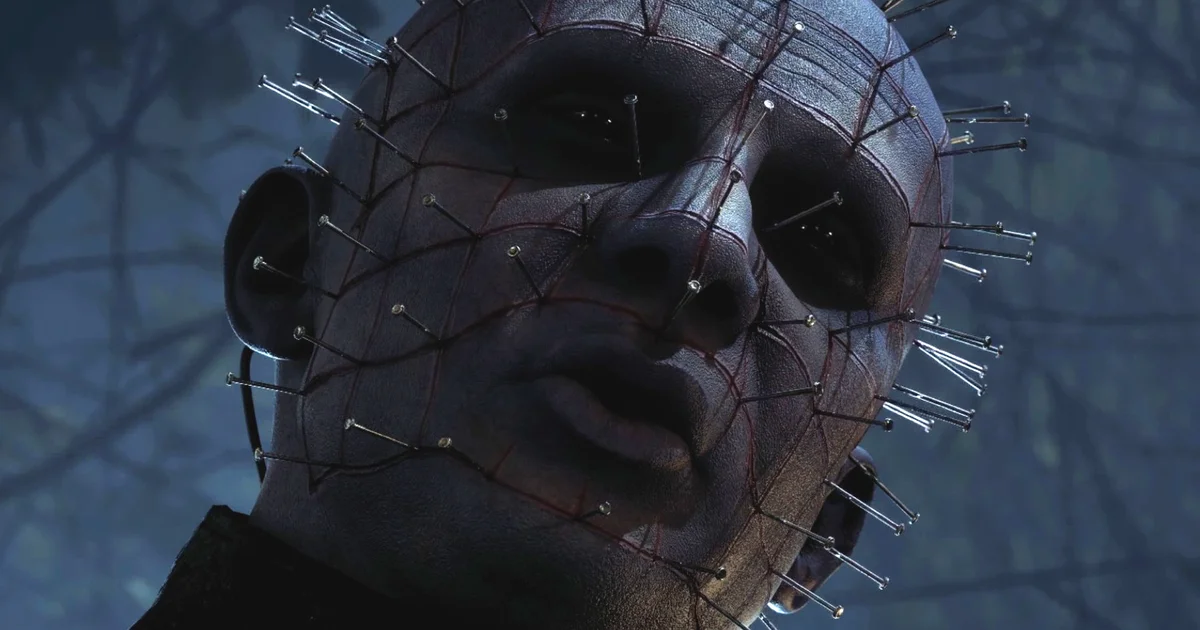
Clive Barker’s 1986 novella The Hellbound Heart, the genesis of the Hellraiser series, is a queer horror classic; a story of obsession and addiction, loosely inspired by the gay BDSM scene. Later Hellraiser movies would see the series devolve into silliness, iconic villain Pinhead (played by Doug Bradley, who briefly returns here) becoming a quipping counterpart to the Freddies and Chuckies of the time. But Saber Interactive seems to have more literary ambitions for its tale of two lovers and their encounter with the Cenonbites; extradimensional beings from a realm where agony and ecstasy are one and the same. It’s a story that starts with sweaty softcore sex and soon descends into flesh-ripping violence, setting protagonist Aiden against an extreme BDSM cult as he desperately attempts to rescue his girlfriend Sunny back from Hell. Unfortunately, their relationship is so immediately toxic, it’s hard to get emotionally invested in this critical narrative throughline.
Tonally, Hellraiser is a very strange game. Instead of artfully orchestrated scares, Revival’s horrors rely on a grim procession of fused and rended flesh, as relentless as it is effectively offputting. But the ceaseless bodily destruction sits awkwardly alongside villains so deliriously flamboyant, they’d be twiddling their moustaches if it weren’t for their masks, while attempts at eroticism and sensuality quickly short circuit amid the dildo-strewn nightclub neon, where extras spit out porn-calibre line readings of flat innuendo. Narratively, it’s a bit of a mess; too obvious and too incoherent by turns, clumsily walking through a minefield of complex ideas – most obviously, the intersection of sex and violence – with all the subtly and nuance of a double-A FPS with an interactive paddle spanking scene. But to its credit, it just about manages to avoid feeling exploitative, and there is, I think, an earnestness to Revival that carries it through.
This is the work of a studio, you sense, with a real love of the source material, and a desire to do it justice. And that manifests in a game willing to take some unexpectedly big swings. They don’t always work, but at least it’s interesting. Take combat, for instance. Revival is, foundationally at least, a fairly bog standard FPS, and it’s not long before an early dalliance with perfunctory stealth makes way for more confrontational action. You start with a pistol and, soon enough, your arsenal swells to include a shotgun, a revolver, an SMG, and more; an enigmatic old woman setting up stall every now and then to sell you new toys and upgrades (it’s not the only time Revival feels like it’s channeling Resident Evil 4). Eventually, you’re mowing down the Unworthy armed with laser-site pointers and incendiary shells, which should be the absolute antithesis of horror, but Saber just about makes it work.
For starters, Aiden moves with a satisfying sense of physicality. He wobbles when he runs, sidesteps with weighty momentum, and, when the melee weapons come out, he bludgeons and slices with sickening tangible abandon. And while it might be very action-heavy, Saber finds tension in withholding. Weapons break, ammo is short, and even the most basic enemies take a good few hits to bring down. Throw in armoured foes which need to be stripped down first – either with a swing of something heavy or a particularly aggressive blast – and every combat encounter feels like it’s perpetually teetering on the brink of disaster. But Revival strikes a good balance between stressful and unfairly punishing.
And while I don’t love the modern day proliferation of crafting systems, the focus on furious scavenging here feels additive. It heightens the sense of last-gasp desperation as you pocket everything, in the hope you’ll have enough on you to eke out a couple more health packs or bullets when things go wrong. Your limited inventory space, meanwhile, forces some tough choices as you desperately shuffle, stash, or abandon, optimistically Tetrising together the most effective arsenal from the scraps at your disposal.
Later, Revival’s iconic puzzle box – here, the Genesis Configuration – essentially becomes a gravity gun, letting you rip through multiple opponents at once as you hurl sawblades, spikes, even fireballs. And if you’re short on the Suffering needed to power it, just wait until an enemy is on its last legs and you can gruesomely syphon it right out of them. Combat’s pilfered parts might feel Resident Evil by way of Half-Life and Doom, but at its best, Hellraiser manages to combine them into an enjoyably ad hoc rhythm of its own – crafting showdowns of pure frantic panic as you scramble to juggle weapons that seem to empty their ammo in seconds, as you desperately scan your surroundings for something pointy to lob at an opponent, and delve into your inventory, desperate jettisoning stuff to make space for whatever feels most pressing at any given moment.
The trouble is Revival spends a lot of time failing to make the most of its tools. Particularly in the first half of the game, progress feels like a linear sequence of combat encounters that are over before they’ve even begun, so quick to wrap up there’s no space to settle into anything like a rewarding combat rhythm. (Conversely, bosses tend to drag on a touch too long.) And it tends to make for a lot of uninspiring busywork in a game that’s already erratically paced, often adopting the relaxed meandering of a walking sim. And while I get what Saber is going for with its inventory system, constantly having to pause a big fight to manually switch weapons in and out of the limited equip-slots feels like a faff too far, and kills momentum.
What saves it though are the set-pieces: cabin in the woods ambushes where you’re suddenly expected to furiously board up the windows while the Unworthy pour in; locked-room faces offs against grasping horrors that can melt into the floor while you’ve barely space to turn, and sudden swerves into smoky hide-and-seek creeping. There’s rarely a big encounter that doesn’t throw in a new twist, and it lends Hellrasier: Revival an infectious, unpredictability that permeates everything.
Few of Hellraiser: Survival’s ideas are original, admittedly, but it’s hard to be bored in a game that pingpongs so incessantly. And just as its real-world action feels like it’s starting to sag, proceedings are usually buoyed by Aiden’s extra-dimensional jaunts into the Labyrinth, where the Cenobites and their demonic deity Leviathan reside. Revival is a good-looking game, but it’s in the Labyrinth – Hellraiser’s Escher-esque, non-Euclidean nightmare of endless, impossibly configured stone – that Saber’s artistry really shines.
I am, I’ll admit, a sucker for video games that delight in impossible spaces, so there’s definitely some bias here, but the Labyrinth’s confounding abstractions are a real high point; trading uneven combat for a shift into puzzles, platforming, and pursuit. It’s rarely complicated stuff: you’ll dodge vicious blades and sneak around violently whirring traps; you’ll stealth to avoid the watchful eye of Leviathan, or use your Genesis Configuration to shift monolithic stone chunks and create new paths. And when the blocks you’re shifting are vast spirals of grinding stone or staircases that seem to unfold on themselves, spinning around as gravity shifts on its axis, sending the world into a disorientating vortex of movement and sound, it helps elevate the whole thing. Likewise, there are a handful of arresting PT-inspired sequences, where memories melt into unreality under Leviathan’s gaze, and even some genuinely effective chase sequences as you flee from a relentless Chatterer – the Labyrinth endlessly reconfiguring itself around you in real-time. These are perhaps the standout; melding spectacle and tension without descending into frustration.
Hellraiser: Revival is not, I don’t think, a great game. It’s too messy and inconsistent to earn that accolade. And there are times – particularly in its uneven opening half – I wouldn’t even say it’s a good game. Tonally and narratively, it’s all over the place, stumbling where nuance is required and struggling to create a strong emotional throughline. It borrows so much for its gameplay grab-bag, it often struggles to find its own identity whenever the Cenobites and the Labyrinthe are off-screen. Its action sometimes sags. But slowly, it begins to find a more confident rhythm. Its combat and encounters grow more engaging, making the most of its tools. And as the line between the Labyrinthe and the real-world begins blurs, the tone settles and the best bits of both halves start to merge. Hellraiser: Revival might be scrappy and inconsistent, but it’s entertaining, and even when it’s not, it’s at least fascinating. Which probably also describes the series as a whole. A bit of pleasure, a bit of pain – how apt!
A copy of Clive Barker’s Hellraiser: Revival was provided for this review by Saber Interactive.