If you remember racing home after school to grab the family landline and call your best friend before dinner, a new device from Pinwheel is aiming to reboot that experience for a new generation.
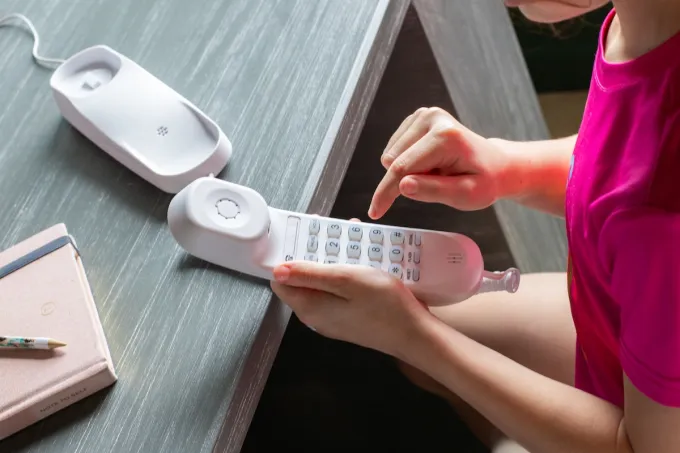
The kid-focused tech company announced Tuesday the launch of Pinwheel Home, a modern take on the classic household phone designed to let children stay connected without the distractions of a smartphone.
Pinwheel is positioning the phone as an intro to phones for children ages 5 to 10 before they’re ready for a smartphone. The company already sells kid-friendly smartphones and launched a smartwatch last year.
Instead of texting or doomscrolling on social media, Pinwheel Home is built solely for voice calls. The company says the phone encourages more meaningful, one-on-one conversations while giving kids the independence to call friends and family and practice basic phone skills without borrowing a parent’s device.
The launch comes as more parents look for ways to cut back on their children’s screen time amid growing concerns about technology’s impact on their development. Studies have linked excessive screen time to emotional, behavioral, and social challenges. Plus, recent research from the University of Georgia found that children who spend more time on social media tend to show weaker vocabulary development over time, including greater difficulty recognizing and pronouncing words.
Notably, while Pinwheel Home looks like a traditional landline, it operates over Wi-Fi, eliminating the need for a phone jack. It comes in two models. The Spark starts at $68 and comes in white, black, blue and purple. The Classic costs $79 and includes a retro-style handset and customizable stickers, with color options of pink, black and white.
For safety purposes, parents control the device through Pinwheel’s Caregiver Portal, where they can approve contacts, block unknown callers, spam and robocalls, and set calling schedules and time limits. Speed dial and voicemail are also available.
The company notes that future updates will introduce three-way calling and allow Pinwheel Home to integrate with its watches and smartphones, enabling children to use the same phone number across devices while still limiting screen time at home.
Countries like Australia have restricted social media access for children, and the U.K. has announced plans for similar measures.
The device also joins other screen-free communication products for kids, competing with Tin Can, a $100 Wi-Fi-enabled landline that allows parents to manage approved contacts through a companion app.
Calls between Pinwheel Home devices are free through the company’s Pinwheel Circle service. Families who want to call standard phone numbers can choose plans starting at $6.99 per month for up to five approved contacts or $9.99 per month for unlimited calling. (For comparison, calls between Tin Can devices are also free, while its friends and family plan is $9.99 per month.)
Pinwheel Home is available now through the company’s website and is expected to launch on Amazon this fall.
Lauren covers media, streaming, apps and platforms at TechCrunch.
You can contact or verify outreach from Lauren by emailing laurenf.techcrunch@gmail.com or via encrypted message at laurenforris22.25 on Signal.
Last chance to save up to $190 on TechCrunch Founder Summit. Join 1,000+ founders and VCs at all stages for real-world scaling insights and connections that move the needle.Savings end June 26, 11:59 p.m. PT.
Satya Nadella has issued a shocking warning to companies using AI Julie Bort
Anthropic starts localizing Claude pricing for India, its biggest market after the US Jagmeet Singh
Phia accused of ‘cookie stuffing,’ taking affiliate credit on purchases it didn’t earn Dominic-Madori Davis
Meta removes controversial AI feature on Instagram after backlash Lucas Ropek
Apple sues OpenAI over alleged trade secret theft Sarah Perez
Elon Musk praises Mythos/Fable, promises not to ‘cut off’ Anthropic Julie Bort
Instagram users: Here’s how to stop Meta’s AI from using your photos Lauren Forristal